Watch the episode
5:26 · MP3 · MP4 · Transcript
Made with AI voices (Sherif, Vera). Sherif's voice is an AI clone, used with his approval. Script researched and written with AI and reviewed by TheCircle.ai.
CiDi unveiled a cabless battery mining truck, natural-language agent orchestration, and autonomous fleet hardware.
Embodied AI Meets Heavy Industry
At bauma CHINA 2026 in Shanghai, Hong Kong-listed technology company CiDi showcased an expanded portfolio of heavy-duty embodied AI and autonomous equipment. The rollout spanned three core business areas: Autonomous Driving, Task Robotics, and Intelligent Hardware and Services.
A central focus of the showcase was Yura, an AI agent built on the MetaMine platform. As Vera notes, this represents "a massive leap from enterprise chatbots to heavy-duty embodied AI," allowing mine operators to issue production goals in plain natural language.
Autonomy-Native Hardware Design
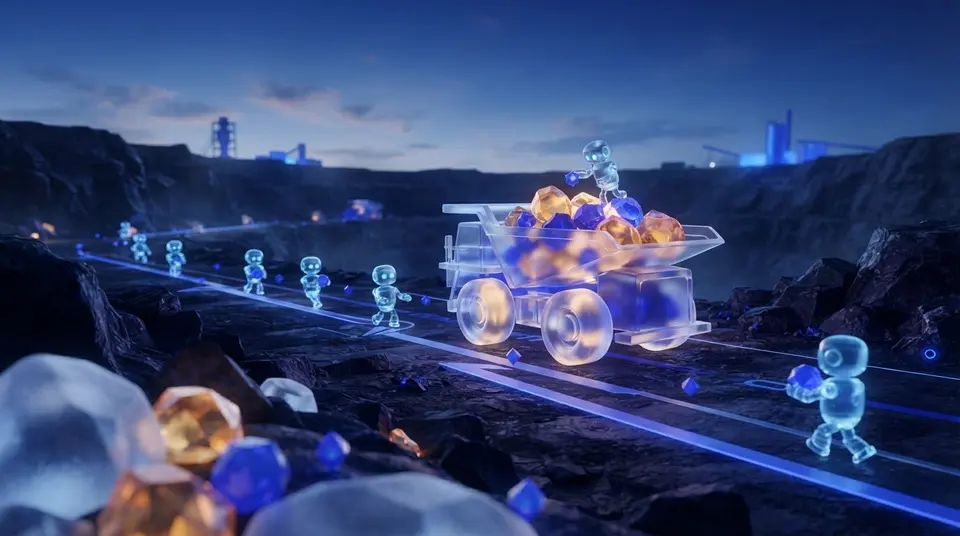
The hardware centerpiece is the CDK155, a second-generation, purpose-built cabless battery-electric autonomous mining truck featuring a 100-tonne rated payload and a 1,056 kWh battery capacity. By removing the human cab entirely, engineers freed up valuable space for sensors, redundant drive-by-wire systems, and massive battery housing.
The vehicle supports both charging and battery swapping, and is capable of recharging from 20% to 80% in 18 minutes. CiDi claims the CDK155 offers a 10% increase in loading capacity, 15% fewer components, a 20% longer service life, and a 10% reduction in maintenance and operating costs compared to conventional trucks in its class.
Full-Stack Orchestration and V2X Communications
Beyond individual haul trucks, the ecosystem integrates underground and on-road machinery. CiDi unveiled the CT17-1S underground drilling robot for semi-autonomous excavation and drilling, alongside the VEGA Level 4 heavy-duty logistics truck co-developed with Zhizi Auto.
The overarching fleet relies on an IPUr Intelligent Onboard Computing Unit and a V2X open-pit mining solution providing millisecond-level communications across vehicles, infrastructure, cloud networks, and personnel carrying TAG safety terminals. According to CiDi, this V2X system is deployed at over 35 mines with nearly 5,000 units installed.
Business Model Shifts and Verification
The company operates as a full-stack systems integrator while utilizing contract manufacturing partners. According to International Mining, the CDK155 is manufactured by a partner in Shaanxi to a 100% CiDi design, with the first unit slated for testing at a customer mine in Xinjiang.
While CiDi has signed cooperation deals with Schaeffler, E-Power, and Zoomlion, and hosted delegations from Maaden's National Mining Company, the episode highlights that operational metrics remain vendor-reported and early-stage industrial deployments require careful validation.
Key takeaways
- Design physical hardware from the ground up for autonomy rather than retrofitting legacy equipment with sensors.
- Utilize natural-language AI agents to translate operational goals directly into multi-machine dispatch tasks.
- Evaluate full-stack systems integration models that separate hardware manufacturing from proprietary software, compute, and V2X layers.
- Verify self-reported vendor performance metrics through independent field testing before scaling autonomous heavy fleets.
Questions this episode answers
What is the CDK155 mining truck?
The CDK155 is a second-generation, purpose-built cabless battery-electric autonomous mining truck with a 100-tonne rated payload and a 1,056 kWh battery capacity.
How does the Yura AI agent coordinate mine operations?
Yura takes natural-language instructions from operators and breaks them down into actionable tasks to dispatch and coordinate haul trucks, electric shovels, and drills.
This article is written from the episode itself (its transcript and the day’s topic brief) and reviewed by TheCircle.ai. The episode cites its original source.
Transcript
Read the full transcript (723 words)
Sherif: We spend a lot of time talking about AI agents scheduling meetings or writing code. But at bauma CHINA 2026 in Shanghai, Hong Kong-listed CiDi showed what happens when an AI agent runs a fleet of 100-tonne cabless mining trucks.
Vera: That is a massive leap from enterprise chatbots to heavy-duty embodied AI. What does that actually look like on the ground, Sherif?
Sherif: It starts with an AI agent called Yura, built on CiDi's MetaMine platform. Instead of people manually coordinating every machine, mine operators give Yura production goals in plain natural language.
Vera: And Yura translates those goals into actual physical tasks?
Sherif: Exactly. It breaks the instructions down to dispatch and coordinate autonomous haul trucks, electric shovels, and drills across the entire mine.
Vera: Right. So it is sitting right above dispatch, perception, and vehicle control. What kind of hardware is it actually bossing around?
Sherif: The centerpiece is the CDK155. It's a second-generation, battery-electric autonomous mining truck with a 100-tonne rated payload.
Vera: And when you say cabless, you mean they didn't just bolt sensors onto an old truck.
Sherif: Right, they removed the human cab entirely. That frees up space for sensors, redundant drive-by-wire systems, and a huge 1,056 kilowatt-hour battery.
Vera: Makes sense. Did they stop at open-pit haul trucks, or does the portfolio go wider?
Sherif: They went much wider. For underground operations, they unveiled the CT17-1S drilling robot, which handles semi-autonomous excavation and autonomous drilling to keep workers out of hazardous areas.
Vera: And I saw they also launched a logistics truck for public roads?
Sherif: Yes, that's VEGA, a purpose-built Level 4 heavy-duty logistics truck co-developed with Zhizi Auto using CiDi's embodied AI controllers.
Vera: What really catches my eye here for executives is the business model shift. Software-first autonomous driving providers are evolving into full-stack systems integrators.
Sherif: Wait, is CiDi building these 100-tonne trucks in their own factories now?
Vera: No, and that's the clever part. A partner in Shaanxi manufactures the CDK155, but it's built to a 100% CiDi design.
Sherif: Got it. So they outsource the heavy metal manufacturing, but own the rest of the stack.
Vera: Exactly. CiDi owns the hardware design, the IPUr onboard computing unit, the agentic layer, and the V2X communications.
Sherif: How does that V2X layer fit in on a rough mine site?
Vera: It gives millisecond-level communications linking vehicles, infrastructure, the cloud, and even personnel carrying TAG safety terminals.
Sherif: Plus, they are building out an ecosystem. They signed 2026 cooperation deals with Schaeffler, E-Power, and Zoomlion, and hosted a delegation from Maaden's National Mining Company in Changsha.
Vera: Which signals they're looking at export markets too. Now, if you're an operator asking about the numbers, CiDi puts some big metrics on the table for the CDK155.
Sherif: Alright. Let's hear them. What does removing the cab actually buy you?
Vera: Compared to conventional trucks in its class, CiDi claims 15% fewer components, a 10% increase in loading capacity, 20% longer service life, and 10% lower operating and maintenance costs.
Sherif: And what about battery downtime? A 1,056 kilowatt-hour battery sounds slow to charge.
Vera: It supports battery swapping and fast charging, claiming it can go from 20% to 80% in 18 minutes. They also say their V2X system is already in over 35 mines across China with nearly 5,000 units installed.
Sherif: Fair enough. Those are serious operational gains, Vera. Where is the catch?
Vera: The caveat is that every single one of those numbers is a self-reported vendor claim without independent verification.
Sherif: Hold on. And how many of these CDK155 trucks are actually hauling rock today?
Vera: According to International Mining, only the very first unit has been manufactured, and it still hasn't undergone customer mine testing in Xinjiang yet.
Sherif: That is a vital reality check. So if an executive is listening to this on Monday, what is the one thing to remember?
Vera: When you evaluate physical AI and robotics for your operations, stop thinking about strapping sensors onto legacy equipment. The real architecture shift comes from redesigning hardware without the human cab and letting an agentic AI layer orchestrate the whole fleet.
Sherif: Design for autonomy from the ground up, but always verify the field tests. Thanks for breaking that down, Vera, and thanks everyone for listening.