Listen to the episode
4:42 · MP3 · Transcript
Made with AI voices (Vera, Sherif). Sherif's voice is an AI clone, used with his approval. Script researched and written with AI and reviewed by TheCircle.ai.
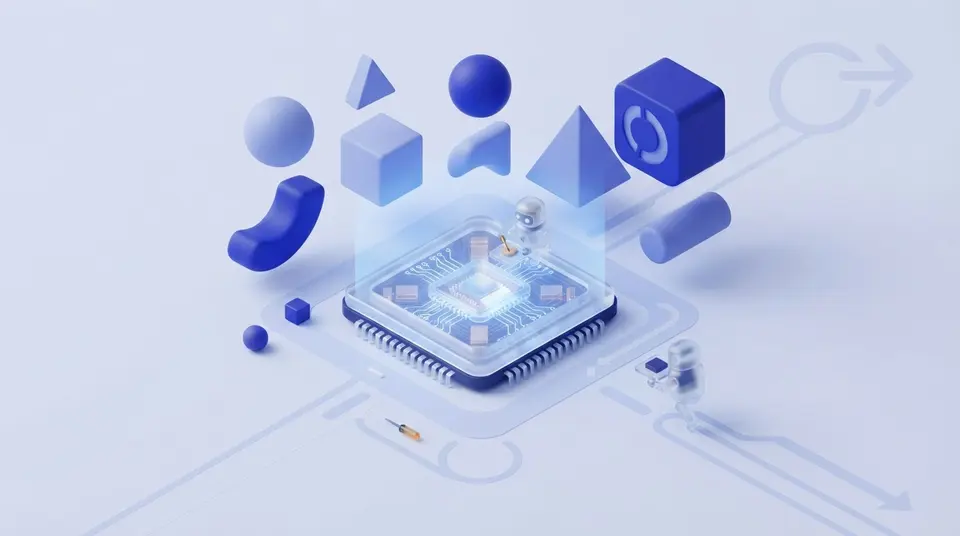
Intel expands its collaboration with Google Cloud to deploy Gemini Enterprise and use cloud infrastructure for semiconductor development.
Expanding Semiconductor Collaboration
Intel and Google Cloud are expanding their collaboration to deploy Gemini Enterprise across Intel and use Google Cloud infrastructure for semiconductor development. Vera argues that this is one of the strongest adoption signals because it is not abstract.
Intel states that Gemini-powered AI will support engineering, supply chain, and corporate operations. Additionally, Google Cloud infrastructure will augment Intel semiconductor development environments.
Custom Agentic Workflows
The collaboration introduces custom agentic workflows intended to speed the chip design life cycle and streamline cross-functional execution. Chip design is complex, expensive, and coordination heavy.
Vera notes that agentic workflows can help with software pipelines, simulations, engineering automation, documentation, expert discovery, and cross-functional handoffs. The value of this approach is cycle time compression.
Hybrid Infrastructure and Governance
Google Cloud will augment Intel on-premises compute by scaling workloads to C4 and N4 instances for complex HPC simulations. This demonstrates how enterprise AI transformation may require both internal infrastructure and burst capacity from hyperscalers.
Vera points out that as employees build and run line-of-business agents, Intel faces governance challenges. The organization requires permissioning, data boundaries, approval flows, logging, and quality control.
Key takeaways
- Look beyond small demo teams and evaluate adoption scope across core business functions.
- Utilize hybrid infrastructure by combining internal compute with cloud elasticity when simulation demand spikes.
- Establish a robust control layer and governance framework when employees build and run line-of-business agents.
Questions this episode answers
What is the goal of Intel and Google Cloud's expanded collaboration?
The collaboration deploys Gemini Enterprise across Intel and uses Google Cloud infrastructure for semiconductor development, introducing custom agentic workflows to speed the chip design life cycle.
How will Google Cloud augment Intel's compute capacity?
Google Cloud will scale workloads to C4 and N4 instances for complex HPC simulations.
This article is written from the episode itself (its transcript and the day’s topic brief) and reviewed by TheCircle.ai.
Transcript
Read the full transcript (712 words)
Sherif: Arthur, did you hear that stories Intel and Google Cloud expanding their collaboration to deploy Gemini Enterprise across Intel and use Google Cloud infrastructure for semiconductor development?
Vera: This is one of the strongest adoption signals in today's brief, because it is not abstract. Intel says Gemini-powered AI will support engineering, supply chain, and corporate operations, and Google Cloud infrastructure will augment Intel semiconductor development environment.
Sherif: The source says the collaboration introduces custom agentic workflows to speed the chip design life cycle and streamline cross-functional execution.
Vera: That is the key phrase. Chip design is complex, expensive, and coordination heavy. If agentic workflows can help with software pipelines, simulations, engineering automation, documentation, expert discovery, and cross-functional handoffs, the value is not just productivity, it is cycle time compression.
Sherif: And in semiconductors, cycle time is strategic. The AI infrastructure market is moving so fast that any acceleration in design, validation, or operations can matter.
Vera: Exactly. This is also a nice example of AI adoption inside an AI supplier. Intel is not just selling AI-enabled chips. It is using agentic systems to improve how the company itself works.
Sherif: Let's separate vendor claim from adoption proof. The claim is that Gemini Enterprise and Google Cloud can help Intel reinvent operations and scale AI workflow. The proof so far is the announced deployment scope.
Vera: Global workforce integration, business functions building line of business agents, and cloud infrastructure for simulations and developer workflows.
Vera: Right. We do not yet have measured ROI, cycle time reductions, or production quality e-vals. But the scope is meaningful because it touches core business functions, not a small demo team.
Sherif: The agentic workflow angle is also practical. Intel mentions coding assistance, engineering automation, and multistep software workflows. That is where agents start to become operational, not conversational.
Vera: And the governance challenge comes with it. If employees can build and run line-of-business agents, Intel needs permissioning, data boundaries, approval flows, logging, and quality control. The more useful the agents become, the more important the control layer becomes.
Sherif: There is a compute layer, too. Google Cloud will augment Intel's on-premises compute by scaling workloads to C4 and N4 instances for complex HPC simulations.
Vera: That is an important hybrid infrastructure signal. Even a semiconductor company with serious internal compute uses cloud elasticity when simulation demand spikes. For enterprises, the lesson is that AI transformation may require both internal infrastructure and burst capacity from hyperscalers.
Sherif: It also shows how agentic AI and HPC can converge. Agents are not only for customer service or office productivity. They can orchestrate technical work around simulations, design workflows, and engineering systems.
Vera: Yes. The most valuable enterprise agents may be domain agents, not generic assistance, but systems wrapped around deep workflows. In chip design, that could mean retrieving prior design decisions, generating test plans, coordinating simulation runs, summarizing failures, routing issues to experts, and maintaining traceability.
Sherif: That is where enterprise adoption gets hard. The model has to understand context, but the organization has to expose the right tools and data safely.
Vera: Exactly. The bottleneck becomes integration architecture. Where is the source of truth? Which systems can the agent touch? What actions are read-only? What actions need approval? How do you evaluate whether the agent made the engineering workflow better?
Sherif: What should Sharif watch next?
Vera: First, whether Intel reports measurable cycle time improvements or productivity gains. Second, whether Gemini Enterprise agents move from support functions into deeper engineering workflows. Third, whether this collaboration expands into silicon co-optimization, where AI tools help design the next generation of AI infrastructure.
Sherif: There is a strategic loop here. AI helps design chips, chips accelerate AI, and hyperscaler infrastructure fills the demand gaps.
Vera: That loop is the story. The companies that master it can compound advantages across software, models, silicon, and operations.
Sherif: My takeaway. Intel and Google Cloud are showing what enterprise AI adoption looks like when it moves into the machinery of the business.
Vera: And the broader lesson is clear. The next enterprise AI winners will not be the companies with the most pilots. They will be the companies that redesign real workflows, connect them to trusted infrastructure, and measure whether the work actually gets better.