Listen to the episode
4:29 · MP3 · Transcript
Made with AI voices (Orion, Vera). Script researched and written with AI and reviewed by TheCircle.ai.
Exploring NVIDIA's Spectrum-6 Ethernet switch system, Vera Rubin factories, and why AI infrastructure is becoming a full-stack systems race.
The NVIDIA Spectrum-6 and Vera Rubin Announcement
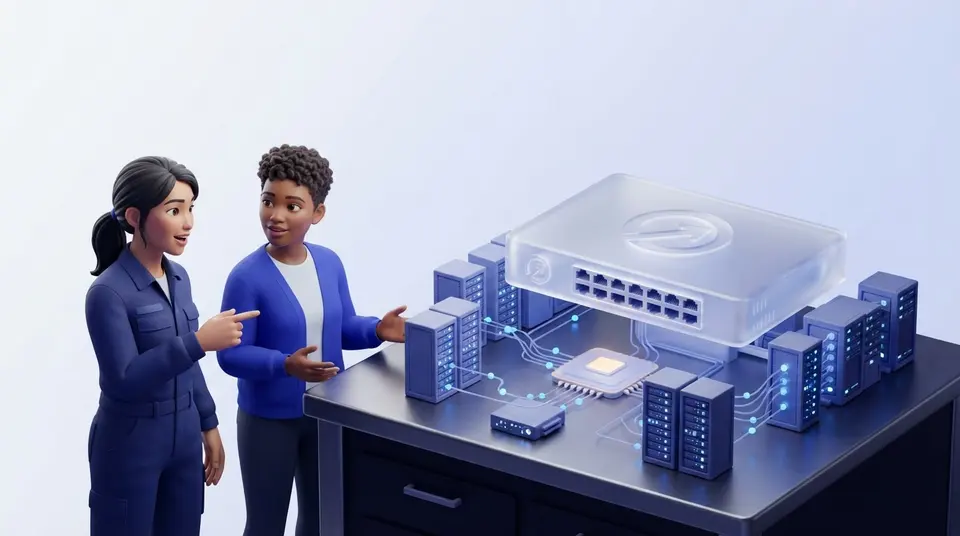
According to Nvidia's official blog published July 21st, 2026, the NVIDIA Spectrum-6 is a 102.4 terabit-per-second Ethernet switch system built as part of the Vera Rubin platform. Positioned for giga-scale AI factories, this release signals a major transition in how the market views enterprise AI capability.
As Vera notes, this "is a system story." NVIDIA is communicating that AI factory performance relies on the entire architecture, spanning GPUs, networking, scale-out fabric, software, power, cooling, and utilization, rather than accelerator count alone.
Moving Beyond Chip Procurement
Executive conversations often center around accelerator acquisition, but large-scale workloads can fail economically if the surrounding system is weak. When networks cannot keep accelerators fed, utilization drops, and training and inference suffer.
Agentic AI further intensifies these infrastructure pressures by creating numerous small, frequent, tool-using inference loops. This workload pattern—involving planning, retrieval, tool calls, verification, retries, and memory updates—places heavy demands on latency, routing, and overall infrastructure economics.
Evaluating Enterprise AI Systems
The current evidence regarding Spectrum-6 stems from product and platform announcements rather than independent customer benchmarks, meaning enterprises should avoid assuming guaranteed performance outcomes.
Instead of asking merely which GPU to buy, enterprises need to evaluate full rack architectures, networking fabrics, realistic utilization rates, and the true cost per training run, inference request, or agent loop.
Key takeaways
- Look beyond accelerator counts and evaluate the entire rack architecture, networking fabric, and power systems.
- Account for agentic AI workloads, which create high pressure on network latency, routing, and infrastructure economics.
- Ask vendors about realistic utilization rates and the true cost per training run or inference request.
Questions this episode answers
What is the NVIDIA Spectrum-6?
It is a 102.4 terabit-per-second Ethernet switch system built as part of the Vera Rubin platform for giga-scale AI factories.
What should enterprises watch for next in AI infrastructure?
Independent benchmarks, real customer deployments, how hyperscalers package capacity, and whether Ethernet-based networking gains ground against proprietary alternatives.
This article is written from the episode itself (its transcript and the day’s topic brief) and reviewed by TheCircle.ai.
Transcript
Read the full transcript (644 words)
Orion: Today's second AI tech signal is NVIDIA Spectrum-6, arriving as the networking layer for Vera Rubin AI Factory.
Vera: The source is Nvidia's official blog published July 21st, 2026. NVIDIA says Spectrum-6 is a 102.4 terabit-per-second Ethernet switch system, built as part of the Vera Rubin platform, and positioned for giga-scale AI factories.
Orion: So, this is not just a faster switch story.
Vera: No, it is a system story. NVIDIA is telling the market that AI factory performance depends on the entire architecture: GPUs, networking, scale-out fabric, software, power, cooling, and utilization. The strategic signal is that enterprise AI capacity cannot be evaluated by accelerator count alone.
Orion: Let's separate claim from proof. The vendor claim is that Spectrum-6 gives the bandwidth, scale, and intelligence needed to operate AI factories as end-to-end computing systems.
Vera: Right. And the proof we have today is product and platform evidence, not independent customer benchmark evidence. Nvidia is making an official architecture announcement. We should not translate that into guaranteed performance or adoption outcomes, but we can say the direction is clear: networking is now first-class AI infrastructure.
Orion: That is important because a lot of executive conversations still sound like: how many GPUs can we get?
Vera: Exactly. But large-scale AI workloads fail economically when the system around the GPUs is weak. If the network cannot keep accelerators fed, utilization drops. If memory movement is constrained, training and inference suffer. If orchestration is poor, expensive capacity sits idle. The bottleneck moves around the system.
Orion: So, Spectrum-6 is part of the shift from chip procurement to AI factory design.
Vera: Yes. And that matters for both training and inference. Agentic AI adds another layer because agents create many, small, frequent, tool-using inference loops. The workload pattern is not just one giant model call. It is planning, retrieval, tool calls, verification, retries, memory updates, and sometimes multiple models. That creates pressure on latency, routing, and infrastructure economics.
Orion: Which means the network becomes part of the product experience.
Vera: It does. If the system is slow, expensive, or unreliable, the agent experience degrades. For AI clouds and hyperscalers, the winner is not only the one with the newest accelerator, it is the one that can package usable capacity at a predictable cost per workload.
Orion: How should enterprises read this?
Vera: Enterprises should ask better questions. Not just: which GPU? Ask: what is the full rack architecture? What networking fabric supports it? What utilization can we realistically achieve? What workloads fit this system? What is the cost per training run, per inference request, or per agent loop? How does this fit into our sovereignty, data residency, and operational constraints?
Orion: That changes procurement.
Vera: It does. AI infrastructure procurement becomes closer to capacity planning for a factory. You need throughput, reliability, input supply, quality control, economics, and clear operating metrics. NVIDIA uses the term AI factory because that is the mental model it wants executives to adopt.
Orion: What should Sharif watch next?
Vera: Watch for three things. First, independent benchmarks and real customer deployments around Spectrum-6 and Vera Rubin systems. Second, how hyperscalers package this capacity into products, pricing, and availability. Third, whether Ethernet-based AI networking gains more ground against proprietary scale-up approaches in enterprise buying decisions.
Orion: And the competitive angle?
Vera: AMD, cloud providers, and networking vendors will all push alternatives. The battle will not be only GPU versus GPU. It will be rack versus rack, fabric versus fabric, and ecosystem versus ecosystem. The cost curve will come from complete systems.
Orion: So the bottom line is: Spectrum-6 is a reminder that the AI bottleneck is not one component.
Vera: Exactly. The AI infrastructure race is becoming a full-stack capacity race. Enterprises that understand the whole system will buy better, deploy faster, and avoid paying premium prices for capacity they cannot actually use.